Offshore Wind in Japan: Why Domestic Production Signals a Major Shift – A Case Study - Monozukuri for Renewables
Offshore Wind in Japan: Why Domestic Production Signals a Major Shift – A Case Study
Monozukuri for Renewables
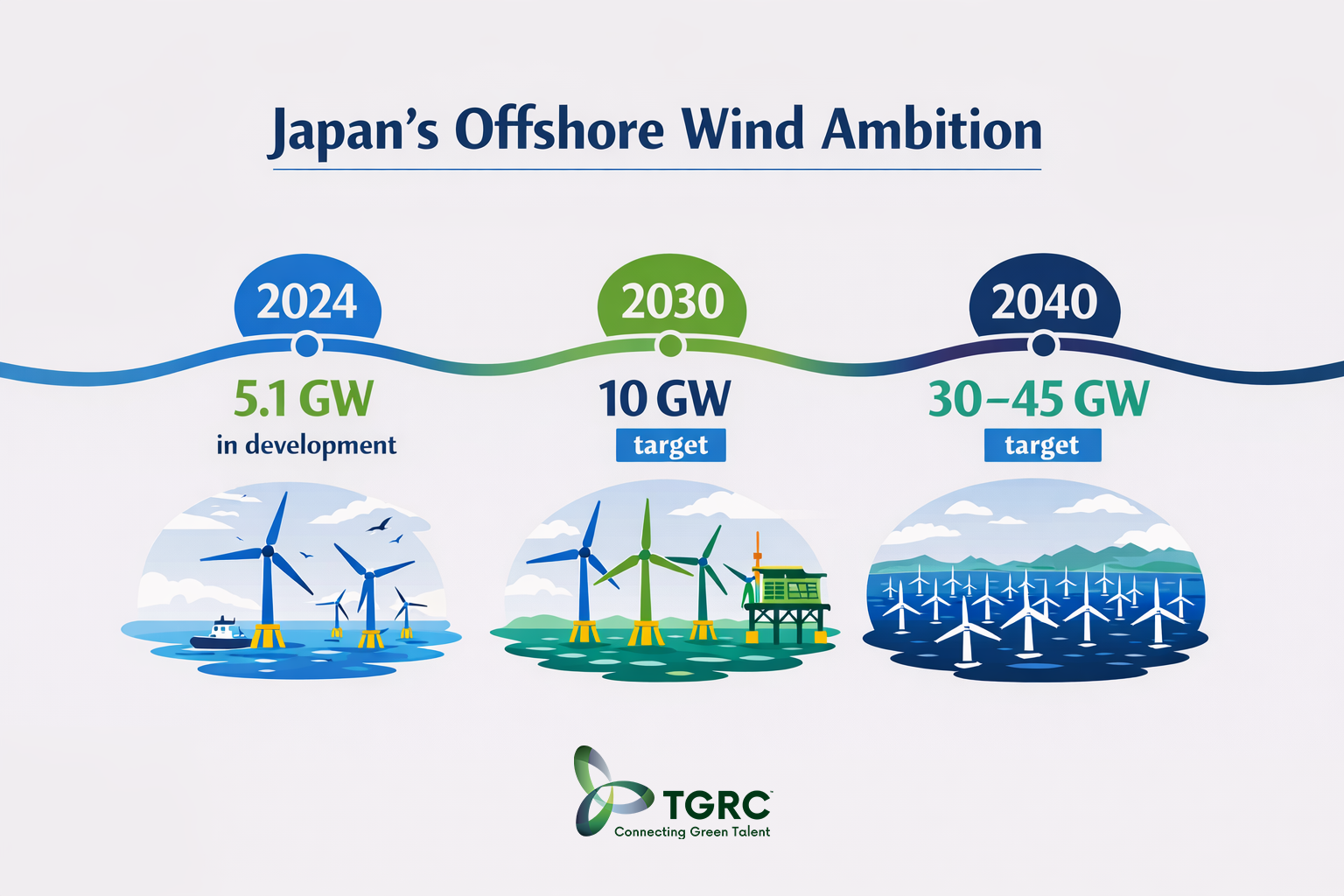
In Japan, the concept of monozukuri—the philosophy of craftsmanship, precision, and pride in making things—has shaped the country’s industrial identity for generations. From shipbuilding to automotive engineering, Japan’s economic rise was built not just on innovation, but on the ability to manufacture complex systems at scale. Yet in offshore wind, one of the defining energy industries of the 21st century, Japan has until recently lacked the domestic manufacturing backbone to match its ambitions. As the country pursues 10 GW of offshore wind by 2030 and up to 45 GW by 2040, the launch of domestic monopile production signals something deeper than a new factory—it represents the return of monozukuri to Japan’s energy transition.
What Monopiles mean for Monozukuri- A Case Study
JFE Engineering's launch of Japan's first monopile manufacturing facility changes this equation entirely. The Kasaoka plant can produce 50 monopiles annually, each weighing up to 2,000 tons and measuring 80 meters in length. These represent some of the largest steel structures ever manufactured in Japan. More importantly, they represent the end of Japan's reliance on foreign foundations.
The economic implications stretch far beyond steel production. Japan's 65% domestic procurement target by 2040, supported by 123.5 billion yen in government funding, could unlock substantial regional benefits. Akita Prefecture alone stands to gain 570 billion JPY in economic value and 52,000 jobs with enhanced local participation. Nationally, the 10 GW capacity target represents 5-6 trillion yen in direct investment and 80,000-90,000 jobs.
Costs remain problematic—roughly double European levels—yet policy reforms are shifting auction criteria from pure price competition toward sustainability metrics. This rebalancing improves project viability while Japan builds the industrial foundation it has lacked for too long.
The question posed by this development extends beyond manufacturing capability. Can Japan's offshore wind ambitions finally align with industrial reality? The answer may well determine whether the country achieves genuine energy independence or remains dependent on foreign supply chains for its clean energy future. JFE Engineering's operational facility provides the first concrete step toward answering that question.
The Foundation for Independence
April 2024 marked a watershed moment for Japan's offshore wind ambitions. JFE Engineering completed the Kasaoka Monopile Factory and commenced operations, followed by a production kick-off ceremony on February 27 for a live Round 2 offshore wind project. The milestone extends beyond mere symbolism – the Oga-Katagami-Akita Offshore Green Energy project will become the first in Japan to utilize domestically produced monopiles. Under contract from Kajima Corporation, JFE Engineering will manufacture and transport 21 monopile and transition piece sets, with production and logistics activities scheduled through March 2027.
The numbers tell a compelling story. The facility represents an investment of approximately 40 billion yen in plant buildings, mechanical equipment, and quay reinforcement. Economic ripple effects stretch well beyond the initial capital commitment, with approximately 400 new positions expected when the plant reaches full operation in fiscal year 2025. The significance becomes clearer when considering this marks the first new facility in approximately 50 years since the establishment of Tsu Works.
Technical innovation underpins the manufacturing breakthrough. JFE Steel's heavy-gage steel plates, branded as J-TerraPlate®, significantly reduce welding length and enable stable mass production. The factory has secured dedicated vessels for monopile transportation, with MOL scheduled to deliver a coastal module carrier in spring 2026 specifically for transporting offshore wind turbine foundations from Kasaoka to construction sites across Japan. These elements combine to create what Japan has long needed: a complete domestic supply chain for offshore wind foundations.
The Supply Chain Challenge Beyond Steel
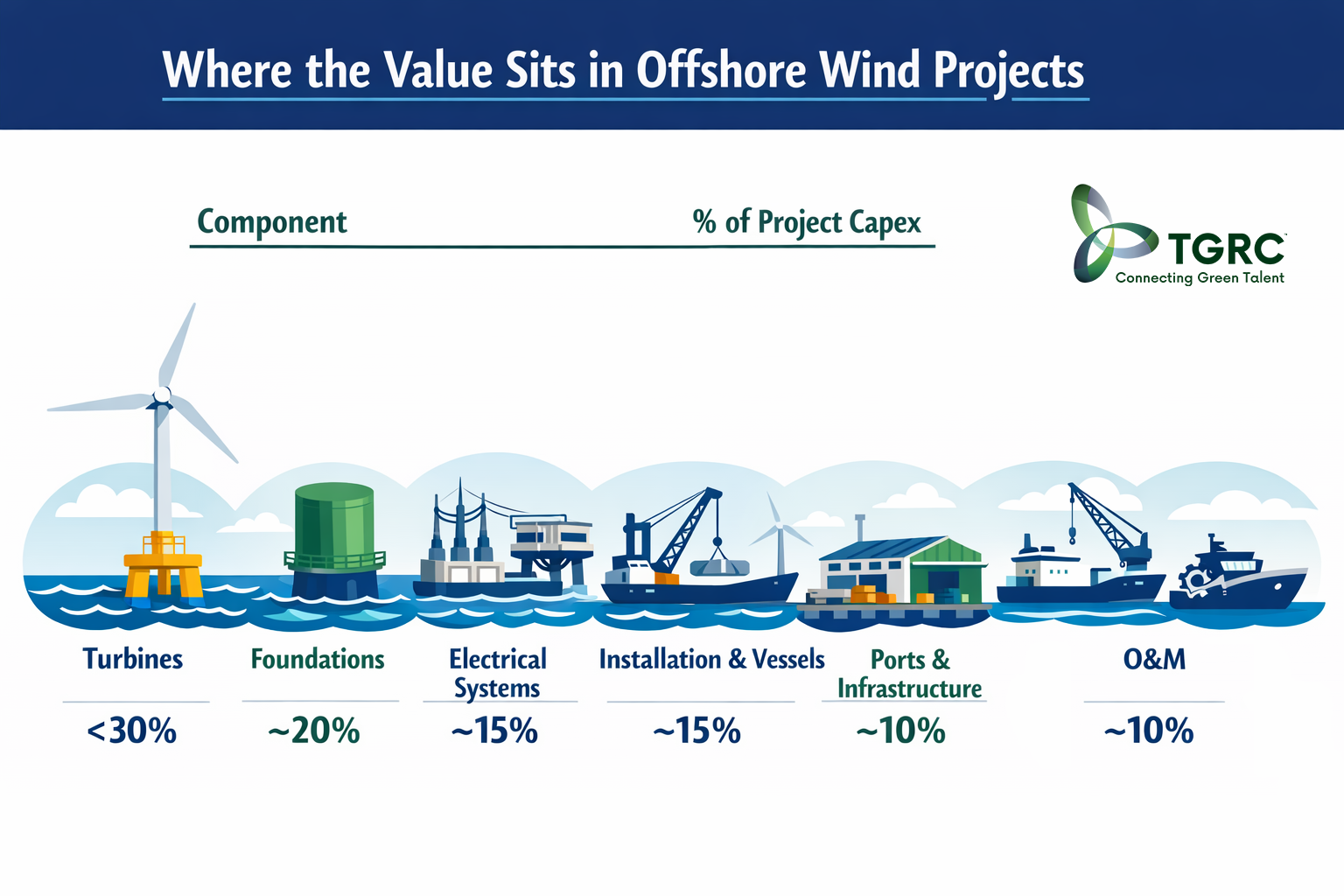
Monopile production solves just one piece of a considerably more complex puzzle. Japan's ambition extends far beyond foundation manufacturing - the country aims to achieve a domestic procurement ratio of 65% or higher by 2040, with some targets reaching 70%. This represents a significant shift when you consider that turbines account for less than 30% of total offshore wind capex in Japan. The remaining 70% consists of balance-of-plant components, including towers, cables, transmission systems, installation vessels, port upgrades, and operations.
The opportunity aligns remarkably well with Japan's existing industrial DNA. Specialty steel production, heavy fabrication, electrical equipment, shipbuilding, and marine logistics represent decades of accumulated expertise. These are precisely the capabilities required for a thriving offshore wind supply chain.
Foreign manufacturers have recognised this reality and are establishing production footholds to meet localisation requirements. Vestas signed a memorandum of cooperation with METI to conduct final nacelle assembly in Japan by fiscal year 2029, subject to securing firm orders through the auction system. The company has mapped out a roadmap toward establishing a fully integrated nacelle manufacturing base by fiscal year 2039. Siemens Gamesa has taken a similar approach, establishing a cooperative framework with METI to facilitate dialogue on developing offshore wind turbine supply chains.
The government is backing these industrial ambitions with 123.5 billion yen from the Green Innovation Fund, supporting development of component technologies such as turbine foundations, maintenance, and electrical systems. This represents more than financial commitment - it signals recognition that energy independence requires industrial capability.
The Numbers Tell a Story
Recent analysis by ERM Japan and Ocean Energy Pathway reveals what happens when energy projects actually benefit local communities. Offshore wind projects in Akita Prefecture alone could generate approximately 356 billion JPY in gross value added and support nearly 34,000 jobs under current conditions. With targeted investments to boost local supplier capabilities, these figures could rise to around 570 billion JPY and 52,000 jobs over project lifespans.
The timing could not be more critical for Akita. The prefecture faces the worst demographic decline among Japan's 47 prefectures. Much like how renewable energy could help revitalize the Navajo Nation in the US, offshore wind offers Akita a genuine path toward regional renewal through increased local incomes and meaningful employment opportunities. The key lies in maximizing local participation in operations and maintenance activities, creating long-term project pipelines for supplier certainty, and coordinated supply chain development across neighboring prefectures.
Scale these regional benefits nationwide and the potential becomes staggering. Installing 10 GW of offshore wind capacity by 2030 could deliver 5 to 6 trillion yen in direct investment and create 80,000 to 90,000 jobs. The construction phase alone is estimated to generate employment ranging from 30,000 to 70,000 jobs annually, peaking around 2040 at approximately 70,000 jobs.
Yet cost remains the elephant in the room. Japan's offshore wind capital expenditure stands at roughly 900,000 JPY per kW, approximately double European levels. Severe marine conditions requiring typhoon-resistant designs, limited domestic supply chain capacity, and smaller project scales drive these elevated costs. However, policy reforms are underway. Auction evaluation criteria are shifting from pure price competition toward sustainability and viability metrics. This represents a fundamental change in how Japan values energy projects - not just by their cheapest upfront cost, but by their long-term contribution to economic resilience.
Conclusion
Japan's offshore wind sector has relied on foreign manufacturing for far too long. With JFE Engineering's monopile factory now operational, the country finally has the foundation for true supply chain independence. The path ahead remains challenging, given that costs are roughly double European levels. Nevertheless, with 65% domestic procurement targets by 2040 and substantial government backing, Japan's offshore wind ambitions are transitioning from policy documents to industrial reality.
FAQs
Q1. What is Japan's offshore wind capacity target and how much is currently in development? Japan aims to develop 10 GW of offshore wind capacity by 2030 and 30 to 45 GW by 2040. As of 2024, approximately 5.1 GW is currently in development, indicating significant room for growth in the coming years.
Q2. What is the production capacity of JFE Engineering's monopile manufacturing facility? The Kasaoka facility has a target capacity of approximately 50 monopiles per year. Each monopile can weigh up to 2,000 tons, measure 10.5 meters in diameter, and reach 80 meters in length, making them some of the largest steel structures manufactured in Japan.
Q3. What is Japan's domestic procurement target for offshore wind components? Japan aims to achieve a domestic procurement ratio of 65% to 70% by 2040. This ambitious target extends beyond foundations to include turbines, towers, cables, transmission systems, installation vessels, and other balance-of-plant components that represent approximately 70% of total offshore wind project costs.
Q4. How much economic value could offshore wind projects generate in Japan? Installing 10 GW of offshore wind capacity by 2030 could deliver 5 to 6 trillion yen in direct investment and create 80,000 to 90,000 jobs nationally. In Akita Prefecture alone, projects could generate approximately 356 billion JPY in economic value and support nearly 34,000 jobs.
Q5. Why are offshore wind costs higher in Japan compared to Europe? Japan's offshore wind capital expenditure is approximately 900,000 JPY per kW, roughly double European levels. This is driven by severe marine conditions requiring typhoon-resistant designs, limited domestic supply chain capacity, and smaller project scales compared to more established European markets.